
MOM obligations applicable to Singapore employers of foreign workers during the employment cycle: A valid work pass, monthly levy payment up to date, mandatory WICA insurance, proper accommodation and correct and timely salary. The employment of foreign workers is governed by the Employment of Foreign Manpower Act (EFMA). Offenders face a fine of up to SGD 30,000, a ban on hiring foreign workers, or criminal prosecution. MOM stepped up enforcement of wages, welfare and worker accommodation standards in 2026.
What Are Singapore’s Foreign Worker Rules?
The employment of foreign workers in Singapore is governed by the Employment of Foreign Manpower Act (EFMA). This is Singapore’s main law governing the employment of all non-citizen, non-permanent-resident workers who hold a work pass issued by MOM. EFMA applies to Work Permit holders, S Pass holders and Employment Pass holders. It applies from the day a work pass is issued, to the day it is cancelled or expires.
Employers who hire a foreign worker under the EFMA have a number of mandatory legal obligations. These are not guidelines – they are legal requirements that MOM can enforce, and failure to comply can lead to serious consequences, including financial penalties, bans on hiring and criminal charges in the worst cases.
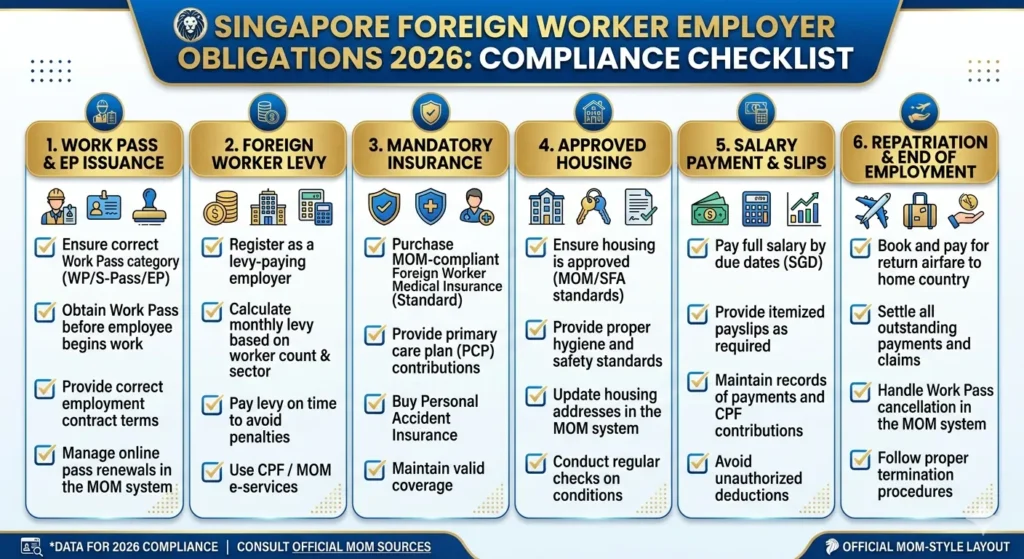
The key areas of employer responsibility under EFMA and MOM regulations are:
- Timely renewal and valid work pass maintenance
- Monthly Payment of Foreign Worker Levy
- WICA and health insurance while employed
- Safe, compliant housing and lodging
- Payment of salary on time and accurately
- Repatriation at end of employment or as required by MOM
If you’re still in the early hiring stage, see our complete guide on how to hire foreign workers in Singapore for the full step-by-step process.
What Are an Employer’s Legal Obligations?
All Singapore employers of foreign workers are legally bound from the first day of the worker’s employment to the last by a core set of responsibilities.
Work Pass Validity
The employer must ensure that every foreign worker at all times holds a valid and current work pass. It is an EFMA offence to work on an expired pass even for one day. Please note that renewal applications should be made at least 6 weeks before the expiry date of the pass to avoid any lapse in validity. For the full application steps and required documents, see our guide on how to apply for a Work Permit in Singapore.
Levy Payment
MOM must be paid the monthly levy by the last day of each billing month. MOM sends out the levy bills on the 14th of each month. Late or missed payments incur penalties of up to 30% of the outstanding levy amount and persistent non-payment can lead to cancellation of all the employer’s work passes and a ban on future hiring.
Insurance
The employer must purchase two mandatory types of insurance for the duration of the employment, namely WICA (Work Injury Compensation Act) insurance for work injuries, and medical insurance of at least S$60,000 per year. The insurance must be in effect prior to the worker’s first day and it is the employer’s responsibility to keep both policies current at all times – lapses are an EFMA violation. For a full cost breakdown including insurance, levy, and MOM fees, see our guide on how much it costs to hire a foreign worker in Singapore.
Salary Payment
MOM’s salary regulations stipulate that employers must pay salaries at the minimum once a month within 7 days from the end of the salary period. Payments should be made through bank transfer or payslip (with proof). Cash payments without proof are not allowed under MOM’s audit framework. MOM has extended role-based wage benchmarks and enhanced payroll documentation requirements from 2026, making salary compliance a higher risk area than in previous years.
Repatriation
Upon expiry of his employment contract, resignation, termination or directive from MOM, the employer is required to pay for the foreign worker’s return airfare to his home country. This obligation is independent of the reason for the departure and cannot be waived or transferred to the worker.
What Are the Housing Requirements?
In Singapore, employers are legally required to provide or arrange safe and adequate accommodation for their foreign workers – in particular Work Permit holders in the construction, marine and process sectors. This is not optional and MOM does regular inspections of foreign worker housing.
MOM housing requirements for Work Permit holders:
- Accommodation must meet the minimum living space standards prescribed by MOM, which is at least 4.5 square metres of living space for each resident.
- The worker’s residential address must be registered with MOM via the Online Foreign Address Service (OFAS) before the issuance or renewal of the work pass.
- Housing must be adequately sanitary, ventilated and have access to cooking and washing facilities.
- Employers shall not house workers in industrial buildings, shophouses or premises not approved for residential use.
- Employers in the construction industry who provide dormitories for their workers must register the dormitories with MOM, and comply with the Foreign Employee Dormitories Act (FEDA).
In 2026, MOM increased checks on foreign worker dormitories and expanded the FEDA’s compliance requirements to more accommodation types. Housing inspections are failed, immediate orders to rectify are issued, and the business is barred from hiring new foreign workers until violations are corrected.
What Are the Salary and Payment Rules?
Singapore’s salary rules for foreign workers are enforced through the Employment Act and the EFMA. Both apply to most Work Permit and S Pass holders. Even if done innocently, getting salary compliance wrong can lead to significant penalties under MOM’s 2026 enforcement framework.
Core salary obligations every employer must follow:
- Pay at least monthly – salaries have to be paid within 7 days after the end of each salary period
- Pay by traceable methods (bank transfer or documented payslip) – non-compliance with cash payments without records
- No deductions without consent — deductions from worker salaries (other than CPF, tax or agreed items in the contract) require the worker’s written consent and must comply with MOM limits
- No Kickbacks or Recovery of Placement Costs – EFMA prohibits any form of recovery by the employer of recruitment, placement or administrative costs from the worker
- Follow sector wage ladders – From 2026, MOM has introduced expanded role-based wage benchmarks for Work Permit holders in construction and services sectors. If you are paying below these benchmarks (even if you are paying above the legal minimum), MOM can come in for an investigation
The Progressive Wage Model (PWM) applies to certain sectors including cleaning, security, landscaping, retail, food services and waste management. Employers in these sectors are required to pay foreign workers at PWM-compliant rates or above — paying below PWM is an immediate offence under the EFMA.

What Happens If You Breach MOM Regulations?
MOM takes EFMA breaches very seriously. The penalties are severe, public and often permanent. Companies that violate Singapore’s rules on foreign workers could be fined or even be criminally charged depending on the nature and seriousness of the breach.
Common EFMA offences and their penalties:
| Offence | Penalty |
| Employing worker without valid work pass | Fine up to SGD 30,000 and/or up to 2 years’ imprisonment per worker |
| Failure to maintain mandatory insurance | Fine up to SGD 10,000 per breach |
| Failure to pay levy on time | Penalty up to 30% of outstanding levy amount |
| Salary non-payment or underpayment | Fine up to SGD 15,000 per offence; debarment from hiring |
| Non-compliant housing or accommodation | Rectification order; hiring ban pending compliance |
| Recovering placement fees from worker | Fine up to SGD 30,000 and/or up to 2 years’ imprisonment |
| Failure to repatriate worker | Fine up to SGD 10,000 per worker |
The most common consequence MOM imposes for repeated or serious breaches is debarment, which is the suspension of an employer’s right to hire foreign workers. Employers that are barred from hiring new workers will not be able to apply for any new work passes until MOM lifts the debarment, and existing passes may be cancelled. MOM publishes a list of debarred employers on its website, which is accessible to the public, candidates and business partners.
What Changed in 2026?
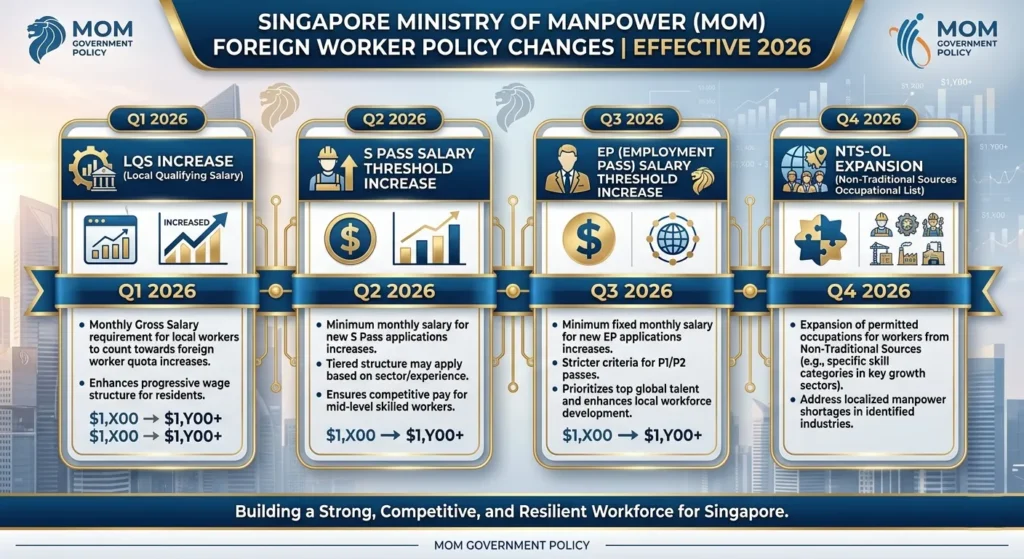
There are a number of notable changes to MOM’s 2026 policy updates announced at the Committee of Supply in March 2026 that have a direct impact on employer obligations.
Key 2026 updates employers must know:
Local Qualifying Salary (LQS) increase
From 1 July 2026, the LQS will be increased to SGD 1,800 from SGD 1,600 per month. Local employees earning less than SGD 1,800 will not be included in the employer’s foreign worker quota. Employers approaching their DRC limit need to take a look at their local workforce payrolls now.
S Pass minimum salary increase
The S Pass minimum salary for new applications will increase from SGD 3,300 to SGD 3,600 per month (general sectors) and SGD 3,800 to SGD 4,000 (financial services) from 1 January 2027. Employers with S Pass holders whose passes are due for renewal in 2027 should review and adjust salary packages before submission.
Employment Pass minimum salary increase
From 1 January 2027, the EP minimum salary for new applications will be increased from SGD 5,600 to SGD 6,000 per month (general sectors) and from SGD 6,200 to SGD 6,600 (financial services).
NTS Occupation List expansion
MOM will expand the Non-Traditional Source Occupation List (NTS-OL) in September 2026, adding eight new occupations in social services, food services and air transport — creating new pathways for Work Permit hiring for employers in these sectors.
Stricter wage enforcement
From 2026, MOM will widen role-based wage benchmarks for Work Permit holders and tighten payroll documentation requirements. Employers in construction and services have heightened audit exposure for wage noncompliance.
Key Takeaways
MOM compliance isn’t a one-and-done thing, it’s an ongoing obligation that spans the entire employment lifecycle of every foreign worker on your payroll.
- EFMA governs all foreign worker employment — from work pass issuance to repatriation
- Levy, insurance, housing, salary, and repatriation are all mandatory — none can be waived or transferred to the worker
- EFMA penalties are severe — fines up to SGD 30,000, debarment, and criminal prosecution for serious breaches
- LQS rises to SGD 1,800 from July 2026 — local employees below this threshold no longer count toward your quota
- S Pass and EP salary minimums increase in January 2027 — begin salary reviews now for renewals and new applications
- MOM wage enforcement is stricter in 2026 — role-based benchmarks and payroll documentation requirements have expanded
- Debarment is public — MOM publishes debarred employers online, damaging business reputation and hiring capacity
Always verify your obligations against MOM’s official employer guidance at mom.gov.sg before making any workforce decisions.

Stay Compliant With 114 Solutions
MOM compliance management across levy payments, insurance renewals, housing obligations, salary rules and work pass validity is a full-time job – especially for employers with large foreign workforces. 114 Solutions is a MOM-licensed foreign worker agency in Singapore, helping employers in the construction, marine, process and manufacturing sectors with their end-to-end compliance needs.
We take care of the entire MOM application process and support you after placement to ensure your workforce remains compliant with every employment contract, including pass issuance, renewal and repatriation.
Get compliance support today: Visit our Employers page or call +65 8112 8544. See our full range of manpower and compliance services for Singapore employers.